



Geosynthetic Characterization Test Facilities
Facility Overview
The Geosynthetic Characterization Test Facilities provide comprehensive mechanical, hydraulic, physical, and long-term performance testing of geosynthetics in accordance with relevant ASTM standards. The facility supports evaluation of geotextiles, geogrids, geonets, geocomposites, and prefabricated vertical drains (PVDs) for applications in roads, embankments, landfills, drainage systems, reinforced soil structures, and ground improvement works.
Major Testing Systems Available
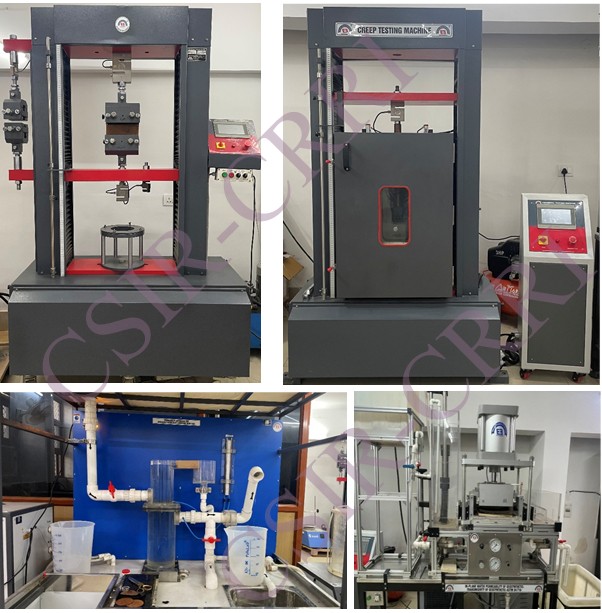
- Universal Testing Machine (UTM) for Geosynthetics
- Servo-controlled system with 100 kN load capacity
- Used for tensile, tear, grab, and puncture tests
- Complies with ASTM D4595, D4533, D4632, D6241, and D4833
- Measures load–deformation behavior for strength, stiffness, and durability assessment
- Creep Testing Machine for Geosynthetics
- Maximum load capacity: 50 kN
- Performs long-term creep and creep rupture tests
- Supports Rupture Holding Method (RHM) and Stepped Isothermal Method (SIM)
- Equipped with temperature-controlled chamber and continuous data acquisition
- Follows ASTM D5262 and ASTM D6992
- Permeability Test Setup for Geosynthetics
- Measures vertical water flow through geosynthetic specimens
- Conducted under controlled hydraulic gradient and normal pressure
- Constant head arrangements
- Determines permittivity and vertical permeability as per ASTM standards (ASTM D4491)
- Used to assess filtration and drainage performance of geotextiles
- In-Plane Water Transmissivity Test Setup for Geocomposites
- Rigid permeability test cell for horizontal flow testing
- Normal stress range: 0–600 kPa
- Maximum specimen thickness: 50 mm
- Conducted as per ASTM D4716
- Determines hydraulic transmissivity under realistic loading conditions
- Full-Scale Drainage Evaluation Setup for Geocomposites
- Transparent acrylic tank (1 m × 0.5 m × 0.3 m)
- Allows testing with or without vertical loading
- Enables real-time observation of filtration and drainage behavior
- Suitable for different soil/GSB and geocomposite configurations
- Thickness Gauge for Geosynthetics
- Measures nominal thickness under specified pressures
- As per ASTM D5199
- Apparent Opening Size (AOS) Testing Device
- Determines filtration opening size of geosynthetics
- As per ASTM D4751
- Digital Density Apparatus (Specific Gravity Method)
- Determines specific gravity of geosynthetics and geomaterials
- As per ASTM D792
Applications
The facilities support testing and research of the use of geosynthetics for:
- Reinforcement of embankments, slopes, and retaining walls
- Pavement and railway subgrade stabilization
- Drainage and filtration systems
- Landfill liners and leachate collection layers
- Erosion control and ground improvement works
Test results help ensure mechanical strength, hydraulic performance, durability, and long-term service life of geosynthetic materials.
General User Instructions
- Specify type, thickness, and configuration of geosynthetic material
- Indicate required test method, load levels, stresses, and duration in advance
- Prepare and condition specimens as per ASTM standards
- Ensure proper handling and gripping during testing
- Use clean water for hydraulic tests to prevent clogging
Contact Details
Dr. Parvathi G. S.
Principal Scientist, CSIR-CRRI New Delhi
parvathi [dot] crri [at] csir [dot] res [dot] in
Upcoming Events
-
Design, Maintenance and Management of Airfield Pavements 14 Dec 2026 to 18 Dec 2026
Photo Galleries
-
CSIR-CRRI Transferred two Technologies...
-
The two-day National Symposium on...
-
CSIR-CRRI conducted specialized...
-
Fit India Pledge – Celebration of...
-
9th Dr. P. Raychaudhuri memorial lecture